Blue Room and the Pods
My journey began with creating Blue Room Loudspeakers, a company that became synonymous with groundbreaking design and exceptional sound quality after our partnership with Bowers & Wilkins. The iconic pod speakers, inspired by the mystique of top-secret us facilities and UFO lore, were more than just audio equipment; they were artifacts of a cultural movement that swept through the electronic music scene of the early '90s. The pods were a physical manifestation of the acid house and electronic underground music culture, embodying the era's spirit and the relentless pursuit of sonic oblivion.
The Housepod was the genesis, a speaker that captured the raw, vibrant energy of house music, designed to deliver the rhythm and soul of the sound in a bassy, bold, and dynamic form as the beats it played. The Technopod followed, a tribute to its namesake's genre; it was more powerful and capable, and with its precision and futuristic aesthetic, it was the first pod design made to work with a subwoofer. When launched as part of a club system, that sub consisted of twenty-four bass drivers. The minipod, perhaps the most recognized of the range, broke the mold with its triple spheroid silhouette and its commercial accessibility. It became an icon of modern audio, celebrated for its ability to project a vast and intricate soundscape from a compact form and not hide away like most box speakers at the time.
The Pod Loudspeaker range became an antidote to the convention of square, box type enclosures. It was functional art that expressed a new way of listening – with your eyes as well as your ears for a generation of people as passionate about personal identity as they were about music. The full story of Blue Room can be found here.
“Pod speakers are the British specialist Blue Room’s simply stunning neobarock introduction into the loudspeaker world”
— Elle decoration

Housepod
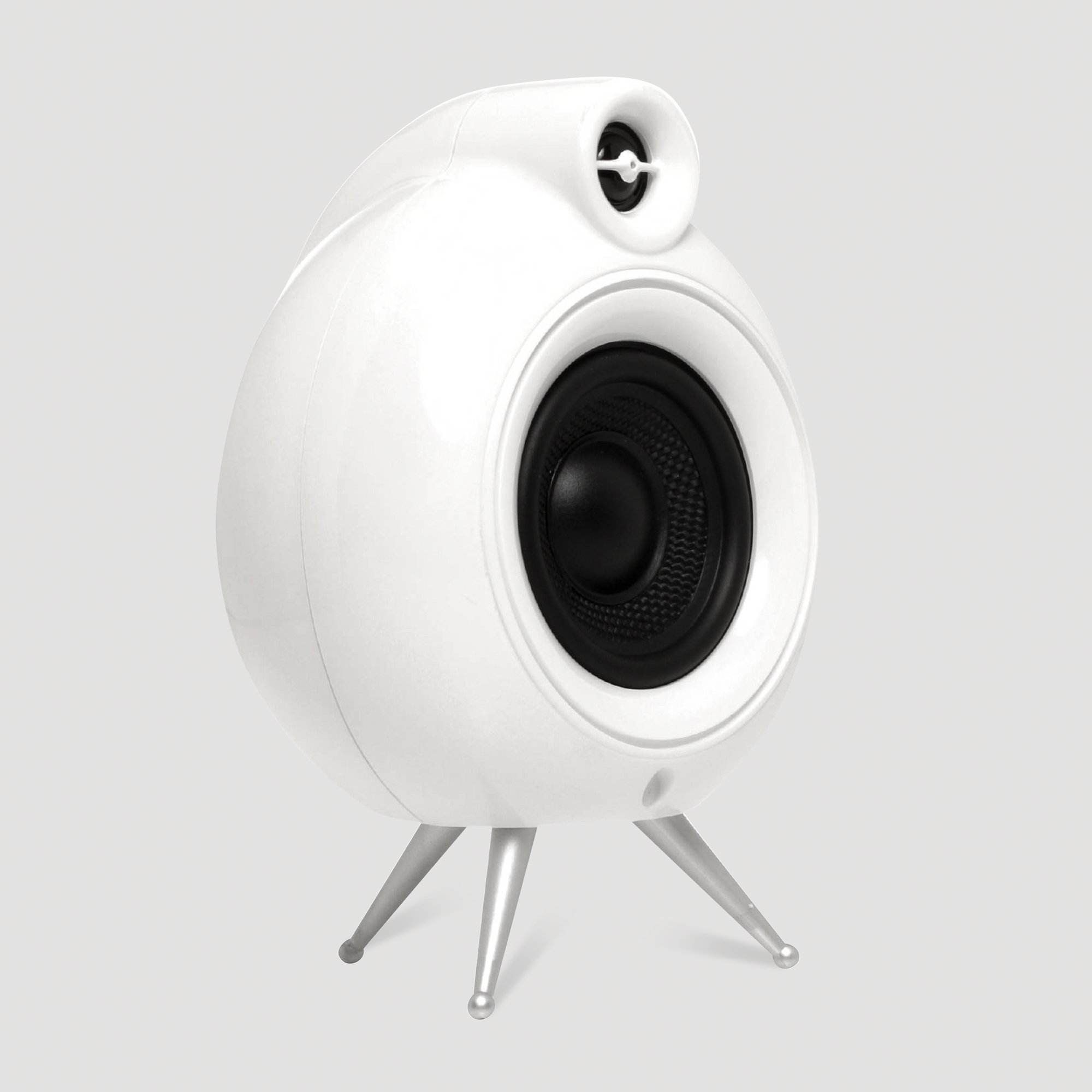
The HousePod was my first design, conceived as a visual representation of the sound it created. The original sketches suggested a form created for sound waves, mimicking nature with its shell-like enclosure. The undulating curves of the HousePod offered significant acoustic advantages over orthodox rectangular speaker boxes. The varying dimensions and curves dispersed internal standing waves and reflections, while the curves around the drivers avoided any baffle-edge discontinuity, which on a box could distort the sound. This design allowed sound waves to move freely, unfettered by the flat surfaces of square speakers. The HousePod won the EISA (European Imaging and Sound Association) award for Audio Design.

Blue Room Loudspeakers
EISA (European Imaging and Sound Association) AWARD WINNER FOR Audio DEsign 95
1993 - white / COMPOSITE with ANODIZED aluminum Sputnik Spikes
HousePod Mk.I with Sputnik Spikes

Blue Room Loudspeakers
1995 - silver / COMPOSITE
HousePod MK. II

1995 - HAND PAINTED by DANIEL DADARA/Composite
COLLABORATION with DANIEL DADARA
HousePod Unique Edition II
TechnoPod
The first Blue Room commercial order for Pods was for a nightclub called The Escape Cub in Brighton. We had just finished the HousePod speaker prototypes, the very first pair of Pods with a simple two-way loudspeaker design. The size of the venue required a more robust solution. Constraints on time meant that we needed a remedy to the slow procedure of pattern and mold creation. My idea was to extend the original Pod pattern's bottom half and replace the shape's bass port part with a second driver. I could design the bottom round and hold the second driver simultaneously because it would be high up on brackets. It allowed the Pod form to 'evolve' more naturally into its new application, elongating the spine to grow from the original design. The shape of the TechnoPod was born.
The opening of Brighton's Escape Club was a complete success, and the sound system was baptized by one of the founders of house music, producer and DJ legend, Todd Terry. The Pod Sound System received critical acclaim, with the UK-based fashion and contemporary culture magazine The Face labeling it a "fierce sound".

Blue Room Sound System with TechnoPod Mk 2 - Escape Club, Brighton - 1993

Blue Room Loudspeakers
1994 - black / COMPOSITE
TechnoPod Mk 2

Blue Room Loudspeakers
1993 - black / COMPOSITE
TechnoPod U-Bracket

MiniPod Mk I with Kevlar
Blue room loudspeakers
1995 - white / COMPOSITE
“If you like your hi-fi to become part of the furniture then we recommend Blue Room Minipod speakers – they have reinvented the aesthetics of speaker design.”
— The Independent Newspaper
MiniPod
The Blue Room MiniPod range redefined traditional speaker aesthetics while creating objects and experiences that inspired an emotional connection. It was hi-fidelity intended for a generation of people who are as passionate about style as they are about music. We created memorable experiences throughout the user journey, from first seeing one - to owning one.
Packaging is integral to the user experience, so we also decided to make that part of the innovative product design. It wasn't just about delivering an amusing sustainability solution; it had to be something you'd want to use.
The wall bracket followed the shape of the MiniPod by rounding off the form at the bottom, like the TechnoPod, while the Sputnik spikes offered options for floor-standing.
The first MiniPod cabinets produced in 1995 were molded in-house from our workshop facility at B&W Loudspeakers by our team from hand-laid FibreGlass Reinforced Plastic, allowing for a seamless cabinet. The expense and time involved would not allow the potential of mass production, so the original MiniPod began life as a relatively exclusive product; only four thousand units were made.
As Blue Room Loudspeakers separated from B&W in 1996 to become its own, the search for new production partners led to the creation of the MiniPod from high-stiffness, recyclable ABS plastic in Denmark.
We included many improvements to the general functionality of the new MiniPod model, including a much-needed makeover to the delicate nature of B&W drivers. Our tweeters were easy to dent, partly due to the dust cap material. We redesigned Child-proof tweeters and driver domes to a new specification to counter any accidental damage from the exposed drivers. The new manufacturing conditions allowed us to experiment with various colors and finishes, including transparent plastics. We celebrated this with the unique transparent Lucente edition.
To keep up with demand and as the production volume increased, robot arms replaced human ones to meticulously paint the MiniPod cabinets in a dedicated spraying facility in Denmark.The electronic arm was programmed to retrace the hand movements of a master painter with thirty years of spraying experience, working around the clock with no breaks, which was both terrifying in a dystopian 'Terminator' type way and simultaneously technologically fascinating.
Future versions of the Minipod have included active (powered), Bluetooth for seamless connectivity and a slightly larger version called the BigPod.

MiniPod Mk II with Kevlar in packaging
Blue room loudspeakers
1997 - Silver / ABS plastic

Blue room loudspeakers
1998 - Silver / ABS plastic
MiniPod Mk II with Sputnik Spikes

Blue room loudspeakers
1999 - midnight blue / ABS plastic
MiniPod Mk II with Pod bracket

Diapason HIFI D'OR 2015
Podspeakers 2016 - matt black / ABS plastic & black ANODIZED aluminum
MiniPod Mk IV Bluetooth with Sputnik Spikes

BigPod Mk I Bluetooth
Diapason HIFI D'OR 2018
Podspeakers 2017 - matt black / ABS plastic
“These well-formed speakers are made to satisfy your ears as well as your eyes”
— GQ magazine

Blue Room Loudspeakers
2001 - silver / ABS plastic
Bass Station
Bass Station
The Bass Station was a subwoofer that grounded the Minipods with depth and gravity, extending their capability into a fuller frequency system.
With the prospect of completing a cinema setup, it was apparent that the MiniPod needed some extra bass extension, so a new design brief was set. Modern music listening and the emergence of home theater have created a need to amplify that bottom octave without wanting to return to prominent and dominant speakers. Traditional sub-woofers have always been large chunky boxes, and because most of them have built-in amplification.
I was inspired by the ancient form of a percussionist's drum for the shape of the MiniPod Bass Station. For many reasons, it made so much logic. The bass driver sits horizontally on top and vibrates like a drum skin, conducting sound through the cylindrical body of the subwoofer cabinet to the tuned bass-port horn sat underneath.
The Bass Station cabinet is created from a two-piece plastic injection molding, internally braced for acoustic rigidity. Its cylindrical form is gently contoured to minimize air turbulence, and the cylindrical enclosure keeps internal resonance at a high frequency to avoid any sound coloration. All the low frequencies emitting from the Bass Station come through the downwards-firing bass reflex port, which flares gently to keep the airflow smooth. Placing the inner end of the port at the center of the bass-station cylinder helps to keep unwanted overtones out of the frequency band. In keeping with the MiniPod the shape is stationed on four aluminum Sputnik spike legs, which also lift the bass port from the floor. A gentle curve sweeps around the cabinet finishing in a teardrop mount for placement of the product badge. The Bass Station is powered and includes 75 watts of amplification neatly concealed on the backside of the cabinet. When the speaker is active, a blue LED light emits behind the front translucent product badge to indicate it is powered on.
This complementary acoustic technology can come from behind the sofa and unobtrusively positioned to join the MiniPods on show.

Bass Station mkII
PODSPEAKERS
2007 -pearl white & matt black / ABS plastic & aluminum
“Blue Room ups the style stakes – the pod is an extraordinary design, has a punchy sound, strong midrange and good tonal balance overall.”
— What Hi-Fi magazine

Blue Room Loudspeakers
2002 - silver / ABS plastic
CinePod
Cinepod
The Cinepod that followed completed the home cinema Minipod 5.1 experience as a center channel while turning up the volume dial, making the Pods more powerful when used in pairs. This project allowed me to work closely again with mentor and acoustic engineer Laurence Dickie.
Dic wanted me to imagine two MiniPods joined together at the tweeter by a ninety-degree angle. This acoustic rule immediately gave an estimated cabinet height, and the volume of the two MiniPods suggested a dimension for overall size. I used these guides to sculpt the form.
The CinePod design process was also an excellent opportunity to explore and incorporate some modifications I wanted to use to update the MiniPod design, such as concealing any wiring in the CinePod. The terminal tray cover solved this and significantly improved the overall flow of the CinePod shape; it also neatly covered the entrance hole of the wall bracket.

CinePod
Blue Room Loudspeakers
2002 - BLACK / ABS plastic
“The satellite speakers are remarkably compact yet they manage to retain a real presence, thanks to the beautiful design.”
— What Video & Widescreen TV magazine
SCANDYNA
2003 - gloss white / ABS plastic
MicroPod Mk. I
MicroPod
The last release , Micropod, offered the essence of the Pod philosophy in a smaller package, making high-quality sound accessible to more spaces and experiences.
The MicroPod SE system was initially conceived as a complete home cinema audio solution, offering the radical nature of the MiniPod on a smaller scale. My first ideas for the MicroPod were based around the shape of the MiniPod from the bottom of the driver and up, removing the port area and surround, making an apparent relationship to the Pod range.
Taking this a step further, I started to experiment with the spine of the Pod and thinning the volume around the tweeter housing. I kept the overall styling and the round element at the bottom of the cabinet modified to incorporate the speaker fixing plate of the bracket assembly, which used a scaled-down version of the MiniPod Omnimount wall bracket.
Future versions of the Micropod have included active (powered) and bluetooth for semaless connectivity.

podspeakers
2017 - matt white / ABS plastic & Aluminum
MicroPod Mk III

SCANDYNA
2004 - gloss black / ABS plastic
MicroPod Mk SE II & Bracket

podspeakers
2003 - gloss white / ABS plastic
MicroPod Bluetooth Mk IV
Current work
Product Design & Partnerships
To Be Announced (current)
Archive
Sound Systems
Product Design
Artwork
Blue Room
Enter the Archive
Related
→ VOYAGER